
The Science
Muscle strength and muscle size play an underappreciated roll our immune system. The study referenced at (1) below demonstrated this.
Exercise of any type has well known benefits to the entire body, the mind, and of particular importance today, the immune system. But precise focused exercise has been shown to have the MOST benefits. (2)
Building even small amounts of muscle has been shown to be a MAJOR contributor to life extension, especially “quality of life” in our later years. If you are not building strength and muscle, even small amounts, you are moving NOT in the direction of health, but away from it.
Diet and long walks alone just do not cut it.
You don’t need to be a body builder to build muscle; you simply need to stress your muscles in a specific yet brief method to build muscle, strength, immunity, and aerobic ability.
Women do NOT need to worry about “bulking up” as that is quite difficult for most people anyway, but building basic muscle and strength can and will occur at ANY age if done in a scientific manner.
That’s worth repeating: you can build strength and muscle AT ANY AGE and it will benefit you in a multitude of ways.
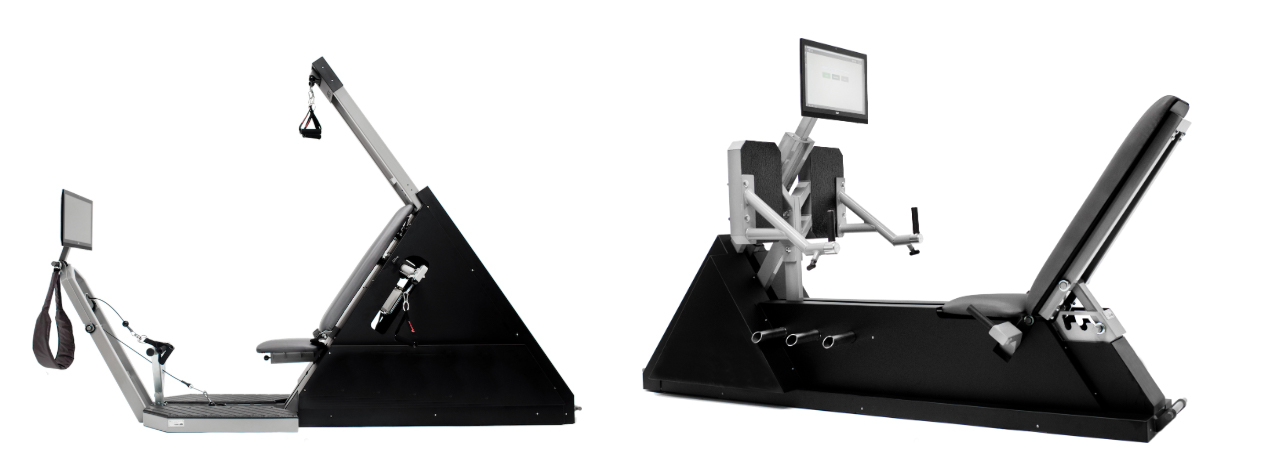
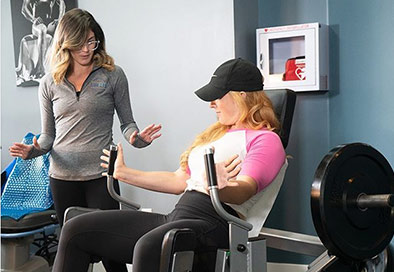
Because we use the most advanced, computer controlled exercise equipment you will start your first session at the exact level that is right for YOU. No overtraining, no unneeded stress and no injuries. We can even work around injuries or limitations that you may already have. Don’t let a small pain stop you from working the rest of your body.
An example is a 80+ year old client who cannot walk on his own so he scooters to our facility. We help him onto the machines and he is then able to get a full work out from a seated position, even though he could not walk here! You can work around existing problems while exercising the rest of your body.
Without getting into a lot of “science” let’s just say that you will have the right work out for you, at that moment in time, every time. If you apply yourself, you should get the most benefit possible in just two 20-minute sessions per week! The most benefit in the least time. Who wouldn’t want that?
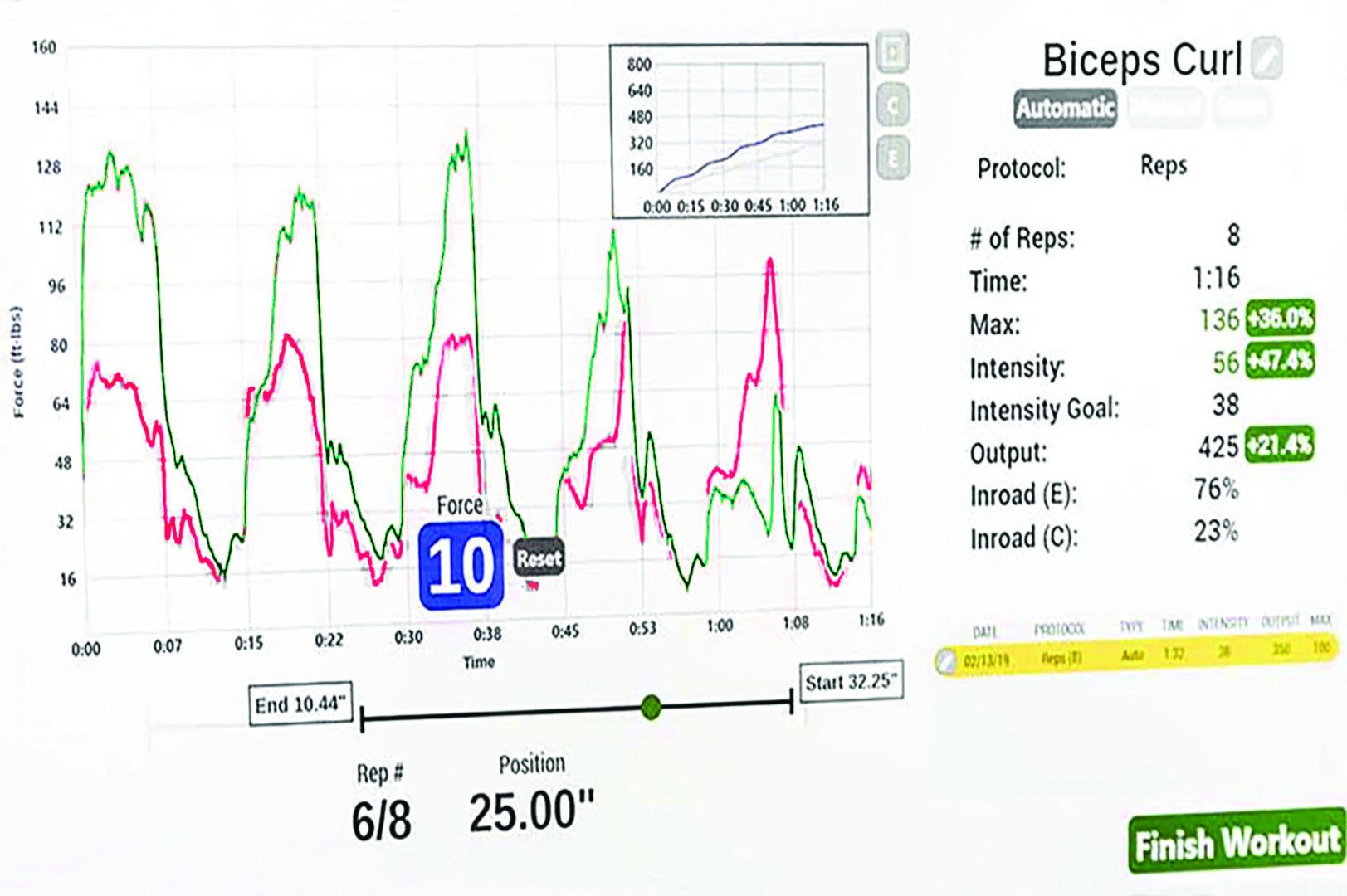
The simple explanation is that our machines sense your current ability and give you the correct resistance based on your strength, adjusting with every second to tone and refine your musculature. The machines also have a computer screen that shows you how much “work” you are doing so that you can track it and compete against yourself in the next session. This equates to improvement, session after session, in the most direct and quantifiable manner.
Building muscle has been shown to be THE predictor of longevity in several studies, one of which is quoted below. (3)
Again, we are not asking you to be a muscle builder but to simply build some muscle. We all lose about 3-5% of our muscle every 10 years after the age of 30. It’s not that it is harder to lose weight as we get older, but that we lose muscle which burns more calories than fat. So body fat gain is oftentimes really muscle loss. Our training system builds strength, tones muscle, burns fat and gives serious cardiovascular benefit in 20 minutes twice a week.
Even if it takes you 20 minutes to drive each way, you will still only have 60 minutes invested in a scientifically proven method with the maximum gains possible.
I have said this over and over to friends, family and strangers, and I will repeat it here:
You won’t understand how effective this technology is until you try it!
An interesting side note is that 95+ percent of all diets fail, in the long run, because dieting encourages a slower metabolism. If you cut 500 calories out of your diet, you WILL lose weight but much of that weight will be muscle. Since muscle burns MORE calories than fat (even when we are NOT exercising) your body’s caloric needs go down after a diet. When you return to normal eating, the weight ALWAYS returns. Science has shown that to maintain your metabolism, you need to keep, or even better build a little muscle. (3)
There are few facilities on earth as complete as Leo’s Fitness Lab! Combine our state of the art technology with highly personalized training and tailored diets, and you’ve got the combination that will change your life.
A 20 minute visit will show you how you can get into shape, get back in shape or, no matter how “in shape” you are now, you will improve your shape, session by session EVERY TIME.
Text or call now to set up a 40-minute demonstration: 619-299-1694
The scientifically proven benefits of our methods in as little as one session a week:
- Reduced body fat levels9
- Increased strength5
- Enhanced cardiovascular efficiency10
- Lower cholesterol levels11
- Reduced chance of injury12
- Stronger immune system13
- Complete metabolic health14
- Increased bone density15
- Reduced risk of Type II diabetes16
- Reduced blood pressure17
- Willardson JM. The application of training to failure in periodized multiple set resistance exercise programs. J Strength Cond Res 2007; 21: 628-31. See also Rodney KJ, Herbert RD, Balnave RJ. Fatigue contributes to the strength training stimulus. Med Sci Sports Exerc 1994; 26: 1160-4.
- https://www.webmd.com/healthy-aging/guide/sarcopenia-with-aging#1This link will open in new window tab,
- Physiologists Carpinelli and Otto reviewed all of the known studies on the optimal number of sets performed for the purpose of increasing size and strength, and found that single sets produced optimal results in 33 studies out of the 35 they reviewed: Carpinelli RN, Otto RM. Strength training: single versus multiple sets. Sports Med 1998; 26: 73-84.
- Carpinelli R, Otto RM, Winett RA. A critical analysis of the ACSM position stand on resistance training: insufficient evidence to support recommended training protocols. J Exerc Physiol 2004; 7: 1-60.; See also Smith D, Bruce-Low S. Strength training and the work of Arthur Jones. J Exerc Physiol 2004; 7: 52-68, and Newham, D. J., Jones, D. A., and Clarkson, P. M. Repeated high-force eccentric exercise: effects on muscle pain and damage. Journal of Applied Physiology 1987; 63(4): 1381-1386
- Messier, S.P., Dill, M.E., “Alterations in strength and maximum oxy- gen consumption consequent to nautilus circuit weight training.” Res Q Exerc Sport 56 (1985) 345
- A. The Globe and Mail article cited a famous study that was conducted at Ball State University in Indiana, researchers put two groups of 10 men through identical 12-week strength-training programs. At the end of the experiment, one group had gained 32 per cent more upper-body strength and 47 per cent more lower-body strength than the other. The only difference was that the more successful group had a personal trainer. https://www.theglobeandmail.com/life/health-and-fitness/fitness/will-i-get-a-better-workout-if-i-hire-a-personal-trainer/article4268225/ B. Researchers at the University of Brasilia in Brazil compared two groups of 100 volunteers who undertook a 12-week strength-training program, supervised either by one trainer for every five athletes, or one trainer for every 25 athletes. The results, which were published in the Journal of Strength and Conditioning. The highly supervised group improved their bench press by 16 per cent, while the less supervised group chose lighter weights and improved by only 10 per cent.
- Burgomaster, S. C. Hughes, G. J. F. Heigenhauser, S. N. Bradwell, and M. J. Gibala, “Six Sessions of Sprint Interval Training Increases Muscle Oxidative Potential and Cycle Endurance Capacity in Humans,” Journal of Applied Physiology 98, no. 6 (June 1, 2005): 1985-90.
- Coyle, “Very Intense Exercise-Training Is Extremely Potent and Time Efficient: A Reminder,” ibid., 1983-84.
- Hurley BF, Roth SM. Strength training in the elderly: effects on risk factors for age-related diseases. Sports Med. 2000 Oct;30(4):249-68. Review. PubMed PMID: 11048773. See also Devries, M. C., Breen, L., Von Allmen, M., MacDonald, M. J., Moore, D. R., Offord, E. A., … Phillips, S. M. (2015). Low-load resistance training during step-reduction attenuates declines in muscle mass and strength and enhances anabolic sensitivity in older men. Physiological Reports, 3(8), e12493.
- Burt J, Wilson R, Willardson JM. A comparison of once versus twice per week training on leg press strength in women.J Sports Med Phys Fitness. 2007 Mar;47(1)
- https://www.ncbi.nlm.nih.gov/pubmed/3824017
- https://www.ncbi.nlm.nih.gov/pubmed/3633121
- https://www.couriermail.com.au/news/queensland/queensland-study-shows-resistance-exercises-can-boost-immunity/news-story/59db6b746b3ac0a6dd90fdb0a7d52bbc
- Campbell, W., Crim, M., Young, C., et al. “Increased energy require- ments and changes in body composition with resistance training in older adults.” Am J Clin Nutr 60 (1994)167–75. See also Hurley, B., “Does strength training improve health status?” Strength Cond J 16 (1994) 7–13. See also Stone, M., Blessing, D., Byrd, R., et al. “Physiological effects of a short term resistive training program on middle-aged untrained men.” Nat Strength Cond Assoc J 4 (1982) 16–20 and Hurley, B., Hagberg, J., Goldberg A., et al. “Resistance training can reduce coronary risk factors without altering VO2 max or percent body fat.” Med Sci Sports Exerc 20 (1988) 150–4
- Menkes A., Mazel S., Redmond A., et al., “Strength training increases regional bone mineral density and bone remodelling in middle-aged and older men.” J Appl Physiol 74 (1993) 2478–84.
- Baldi JC, Snowling N: Resistance training improves glycaemic control in obese type 2 diabetic men. Int J Sports Med24:419–423, 2003
- Colliander E.B. Tesch, P.A., “Blood pressure in resistance trained ath- letes.” Can J Appl Sport Sci 13 (1988) 31–4